
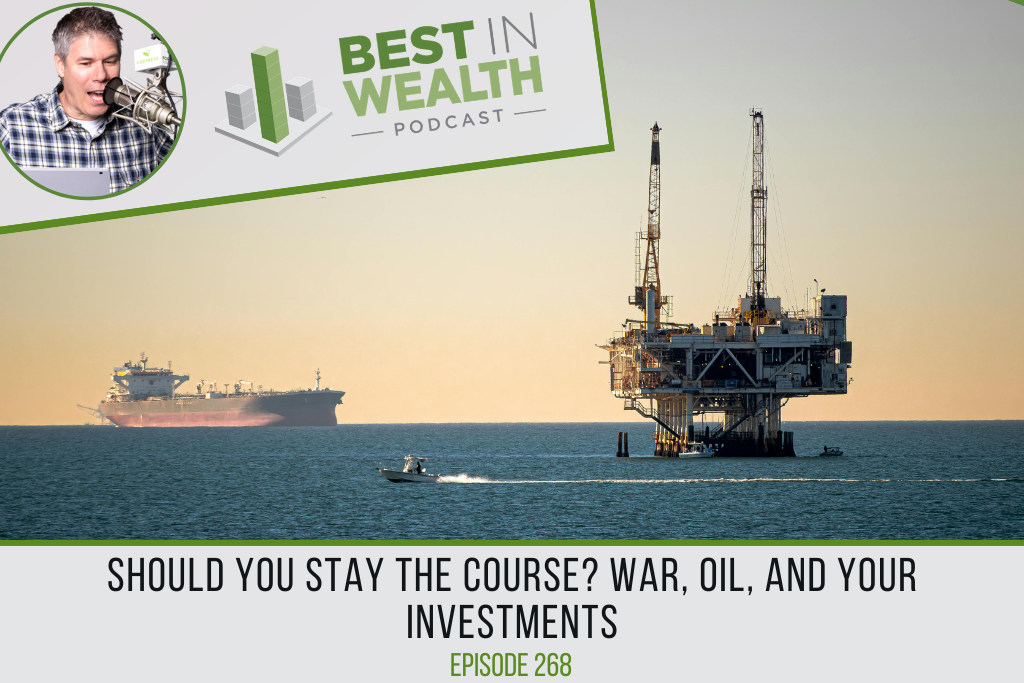
Should You Stay the Course? War, Oil, and Your Investments
Listen to Best in Wealth Podcast Episode 268
How Geopolitical Crises and Energy Price Surges Impact Long-Term Investment Strategy
Watching the news recently has been an uneasy experience for investors and retirees. War headlines and rising geopolitical risk dominate the airwaves, oil prices have surged to new highs, and portfolio balances may not look as reassuring amid rising market volatility. For family stewards looking to safeguard their financial futures, the temptation to react to these geopolitical shocks is powerful. But it is crucial not to make emotional investing decisions.
Outline of This Episode
- [00:00] Retirement planning during uncertain times
- [01:09] Do not make emotional investing decisions
- [07:02] Understanding the VIX Index
- [08:57] The nuanced story of oil prices and your portfolio
- [14:08] Impact of oil on investments
- [18:13] Why timing the market is hard
- [23:26] Staying disciplined during volatility
Understanding the Crisis
In March 2026, military strikes in the Middle East led to severe disruptions in the Strait of Hormuz—a global oil supply chokepoint through which 20% of the world’s daily oil supply flows. Although the U.S. itself is less directly dependent on Middle Eastern oil, oil’s status as a globally priced commodity means any disruption impacts global prices and, by extension, markets everywhere. Brent crude oil prices prices quickly soared, spiking 10–15% in a day and peaking at $120 per barrel, amid fears it could rise further.
Unsurprisingly, the financial markets responded with a bout of market volatility. The VIX index—a gauge of investor fear—jumped from 19 to 25. Though jarring, Speaker A reminds us that these numbers pale compared to the shock during the COVID crisis when the VIX broke 80 (07:02). Recognizing this scale is the first step toward a measured response.
Oil Prices and the Stock Market: It’s Complicated
Many assume a direct, simple link: oil prices soar, stocks tumble. While sometimes true in the short term, history tells a more nuanced story about investing during oil shocks. The real variable is the duration of the oil shock, not the shock itself. In the 1973 Arab oil embargo, prices quadrupled, sustained for months, and the S&P 500 lost 37% in real terms, and recovery took six years.
In the 1990 Gulf War, oil prices rose 75% in two months, but once the conflict was resolved, markets rebounded in just 28 days. In 2003, fears about Iraq pushed prices up, yet the S&P 500 delivered a 25% return the following year as disruptions were short-lived. In general, short, contained shocks resolve quickly with strong recoveries. Prolonged crises cause lasting damage.
Building a Rock Solid Portfolio Strategy
Withstanding economic storms starts with a thoughtful portfolio strategy, and ideally, we want to create a “fortress portfolio”—not a flimsy wall, but a robust structure capable of weathering attacks. This involves deep diversification:
- U.S. small-cap and value stocks
- International and emerging markets
- Real estate investment trusts
- Short-term and inflation-protected bonds
Diversification means that even when panic causes correlations to rise temporarily, the portfolio is designed for resilience, not prediction. Selling during a crisis, by contrast, locks in losses and exposes investors to the impossible challenge of timing the market’s rebound—a decision research shows most people get wrong.
Lasting Wealth Is Built Through Hard Times
War and oil shocks always ignite fear, but history and evidence are clear that those who stay disciplined, trust a well-built portfolio, and avoid emotional, short-term decisions are the ones who preserve and grow wealth. It is not easy to hold the line, but it is the surest path to security and freedom for your family’s future.
Resources Mentioned
Connect With Scott Wellens
- Connect with Fortress Planning Group on LinkedIn
- Connect with Scott on LinkedIn
- Follow Scott on Twitter
- Fortress Planning Group on Facebook
- Subscribe to Best In Wealth Podcast
- View Scott's profile on Fee-Only Network and NAPFA
Podcast Disclaimer:
The Best In Wealth Podcast is hosted by Scott Wellens. Scott Wellens is the principal at Fortress Planning Group. Fortress Planning Group is a registered investment advisory firm regulated by the US Securities and Exchange Commission in accordance and compliance with securities laws and regulations. Fortress Planning Group does not render or offer to render personalized investment or tax advice through the Best In Wealth Podcast. The information provided is for informational purposes only and does not constitute financial, tax, investment or legal advice.